This exhibition takes place on the lands of the Turrbal and Yuggera people of Meanjin. My deepest respects and gratitude belong with the Traditional Custodians of these lands, to Elders past and present. Sovereignty was never ceded.
Never Outshine the Master (Death)
I cannot make you understand. I cannot make anyone understand what is happening inside me. I cannot even explain it to myself.
Franz Kafka, The Metamorphosis (1914)
For years, Meg has applied sunscreen every day.
The habit began after a family holiday to Fiji when, at ten years old, they were severely sunburnt. From then on, sunscreen became less an occasional precaution than a daily ritual. Their father teased them for the habit, convinced they were being overly cautious. In May 2024, after learning that his skin cancer was serious, he returned to the memory with a simple admission: “You were right and I was wrong.” Although they still hoped a series of treatments would be successful, his condition deteriorated over the following months. After a week in hospital, he died from skin cancer on Thursday, 3 April 2025.
It is a story whose meaning and gravity only become legible in retrospect. Sunscreen is designed to protect against damage that cannot always immediately be seen, shielding the body from consequences that may not emerge for years, even decades. So too do the works gathered here. Memory accumulates through ordinary and unassuming materials where emotional weight is not immediately apparent.
With Kafka’s epigraph lingering over this text, itself a small offering to the exhibition, grief resists direct explanation. Between the impossibility of fully articulating inner experience and the certainty of death lies a generative ground that Meg’s installation inhabits. They address losing a parent obliquely, allowing such an emotional experience to settle into objects, surfaces, holes, projections, sound, and ritual. The exhibition suggests that grief is carried less through language or explicit biographical detail than through the patient work of drawing, filming, carving, and welding.
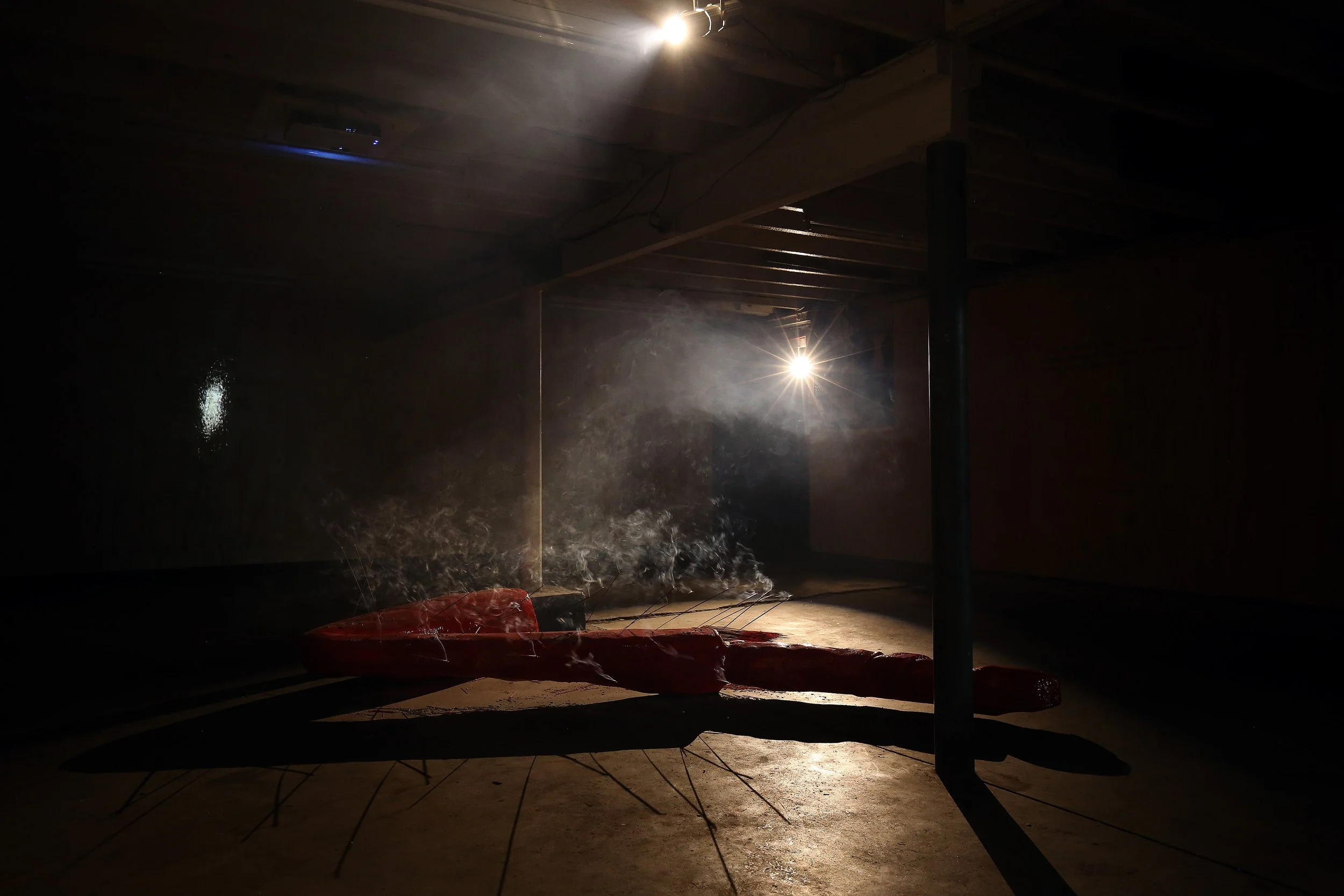
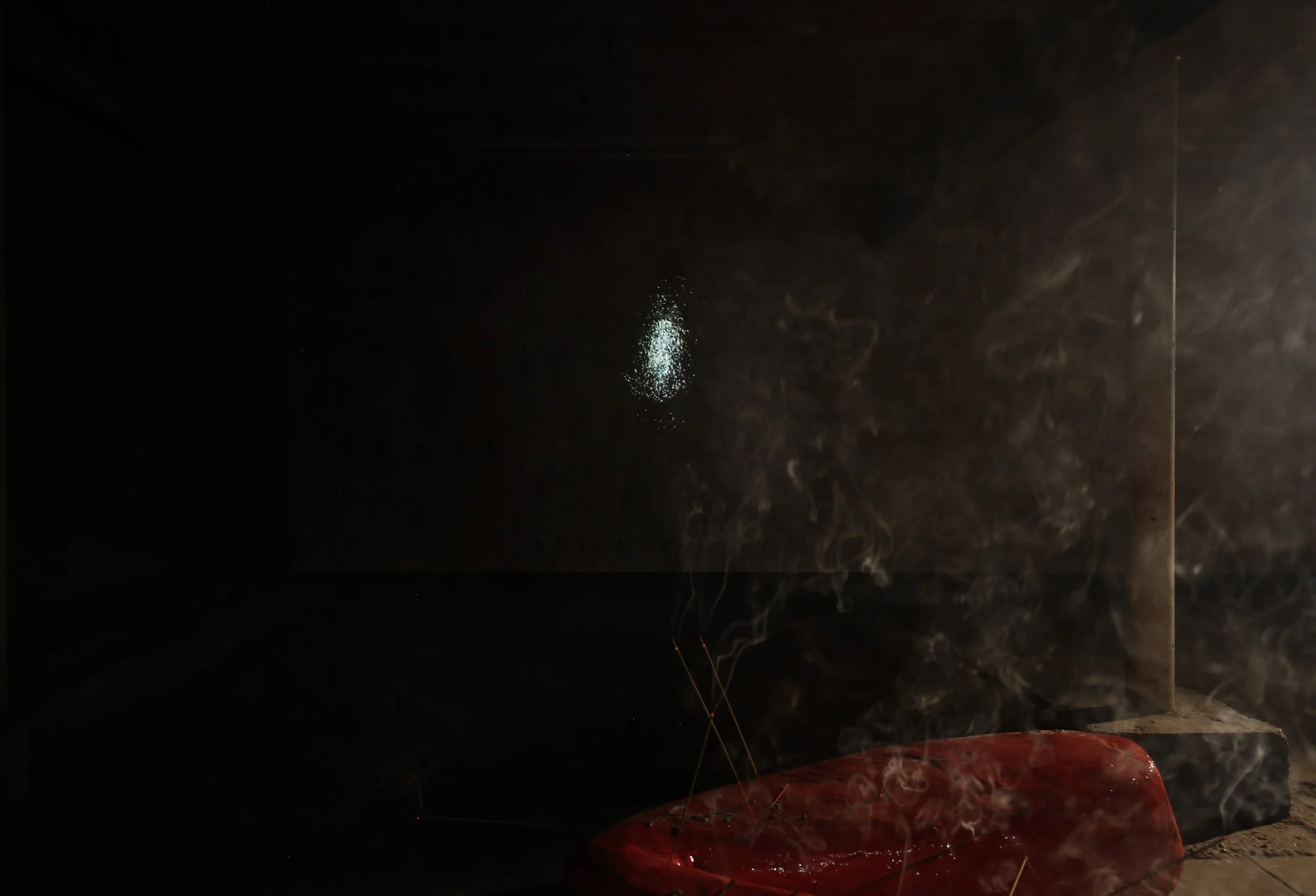
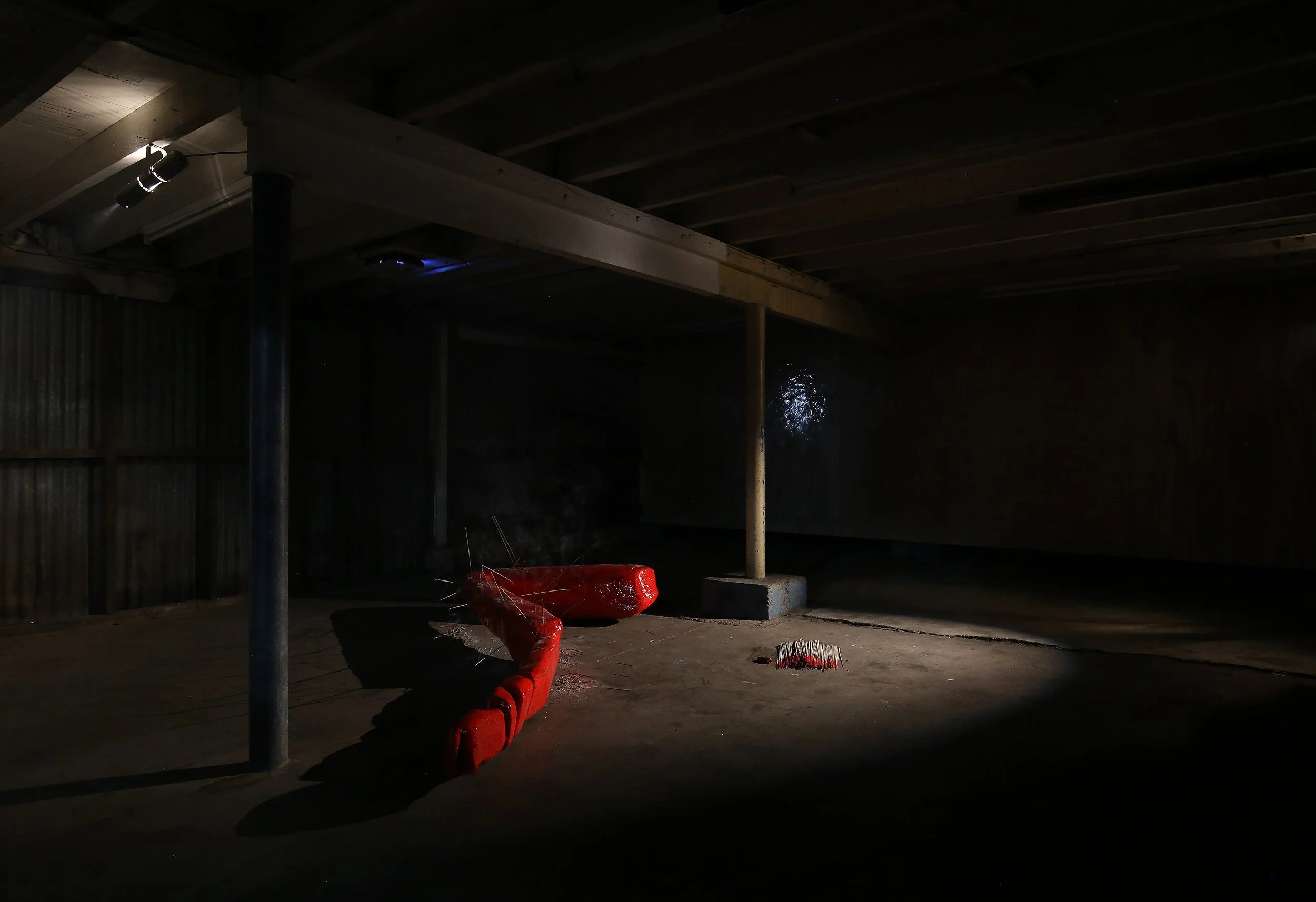
What is carried across a series of works in which surfaces simultaneously protect and preserve? A large projected video records moonlight scattered across the ocean at Kirra Beach on the southern Gold Coast, a stone’s throw from where Meg now resides. Recorded on their iPhone, the video follows moonlight as it breaks apart across the dappled surface of the waves. The moon never appears directly; instead, it exists only as a distorted reflection, continually interrupted by the uneven movement of water. The ocean becomes less a landscape than a shifting membrane, holding only light. An original composition by James Hazel accompanies the projection. Though played on a breathy saxophone, it almost seems to carry the sea within it.
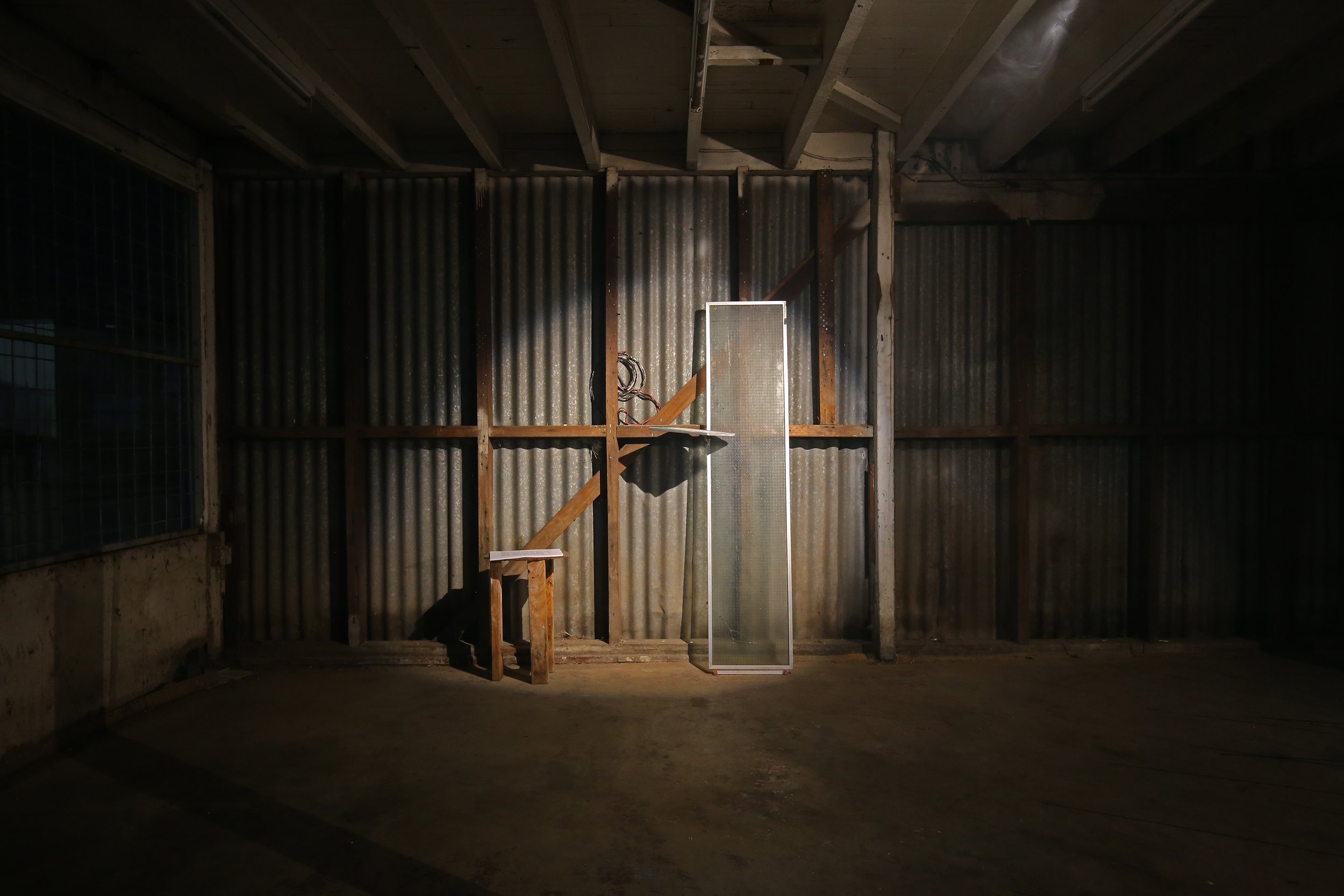
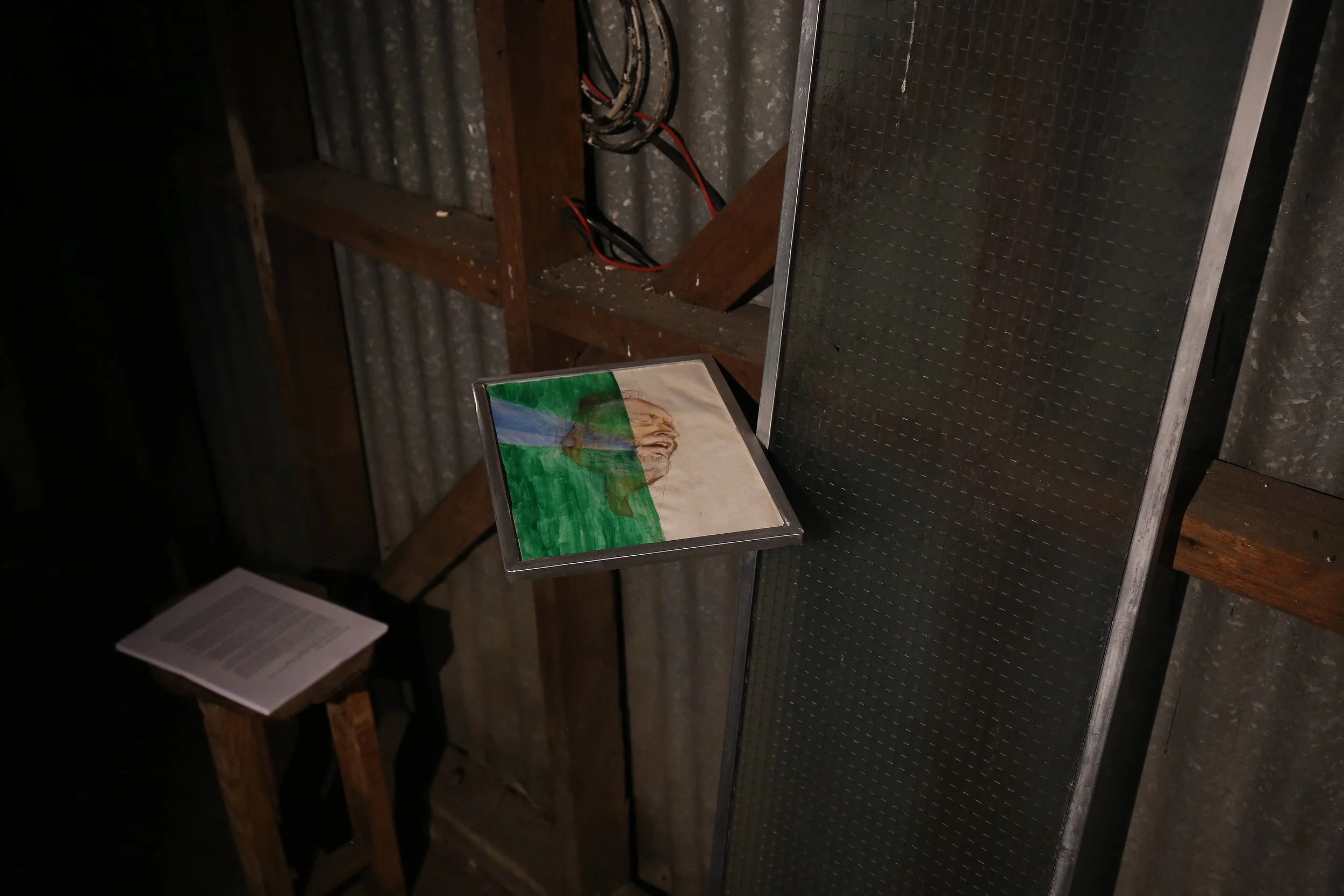
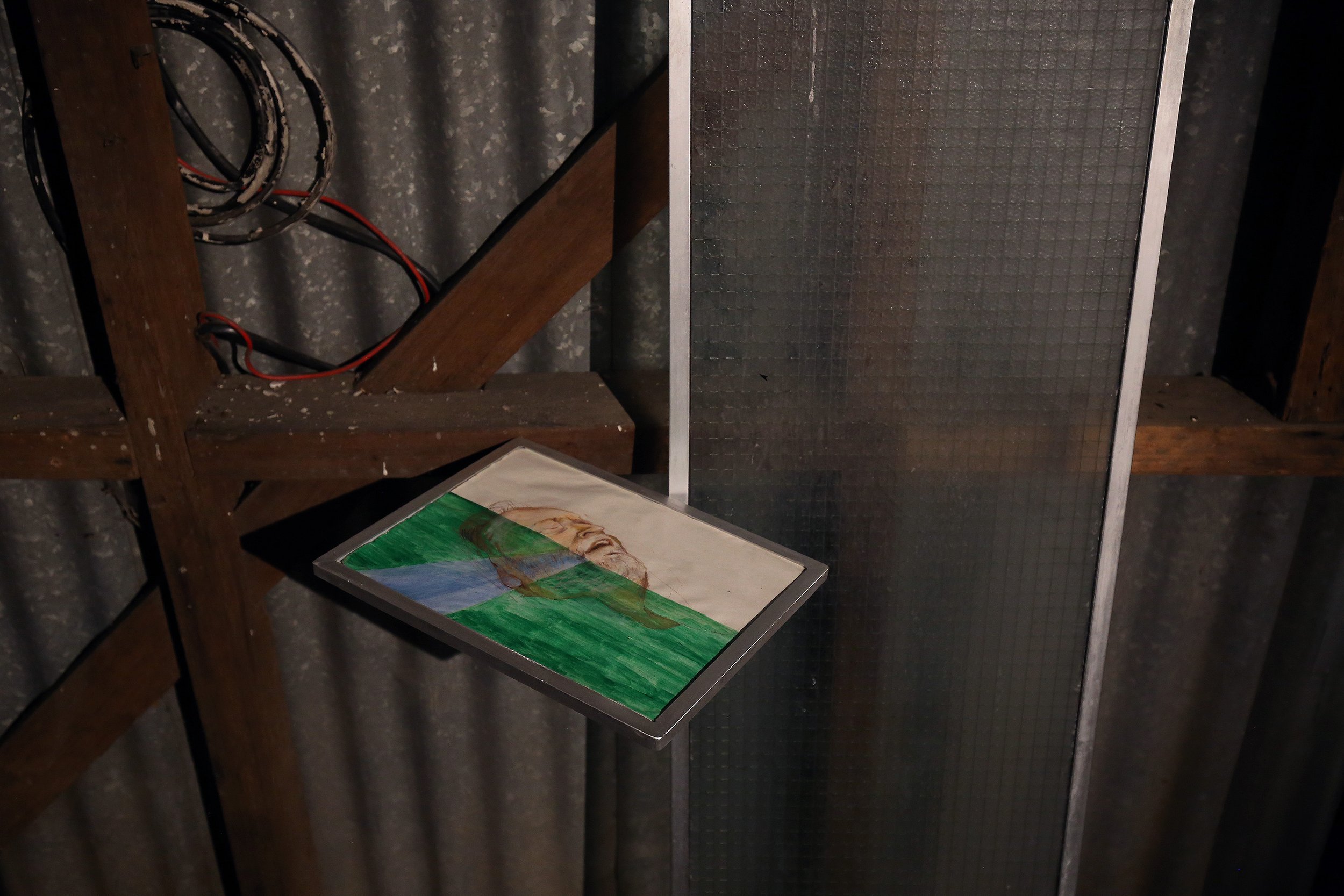
Appearing as a kind of secret work is a study made in hospital on the day of their father's death. Attached to a reclaimed shower screen salvaged from outside Meg’s apartment complex, Kirrarama, the drawing sits at waist height, projecting from the upright pane like a small ledge. One has to approach it and look down to see it. Their father's profile, his mouth gently open, lets in a vivid green form to enter, or perhaps, leave his body. Whether read as breath, water, God, light, or something less tangible, the sketch too contests any symbolic or motif certainty. As T. J. Clark suggests in The Sight of Death, sustained looking rarely produces certainty. It more often reveals how much remains unresolved. Meg’s sketch shares that quality, recording an act of close attention while leaving the coloured planes of blue and green open to interpretation.
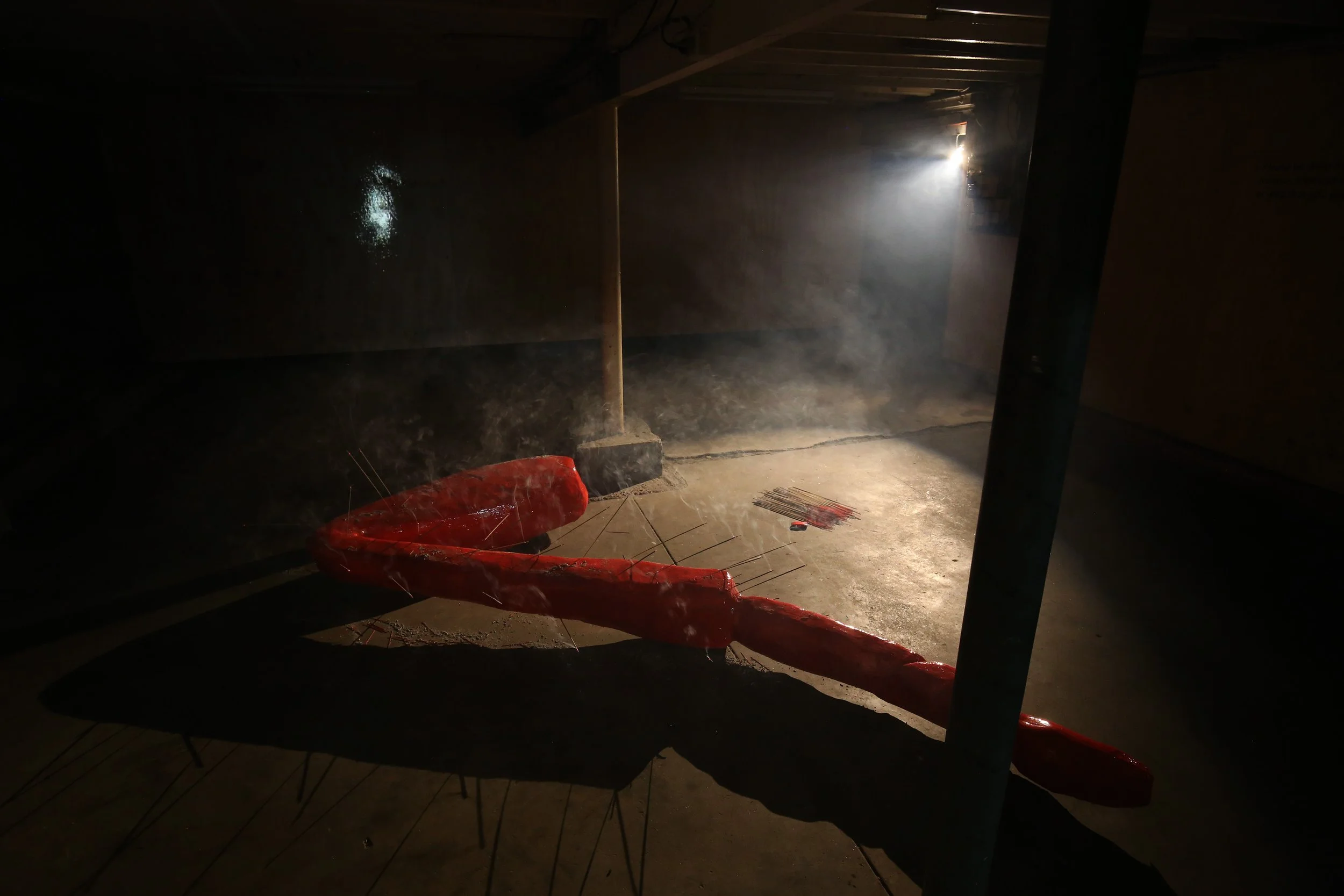
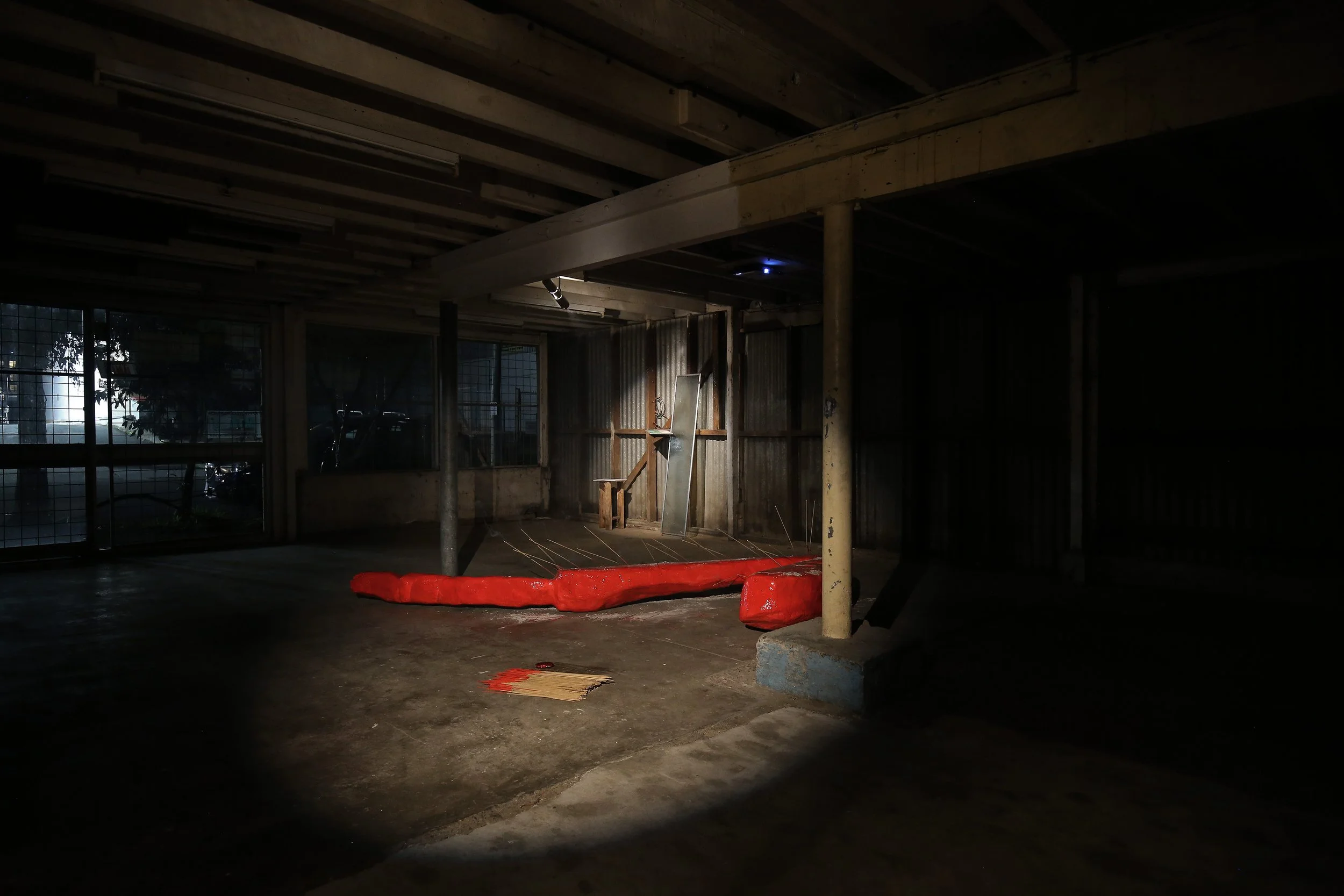
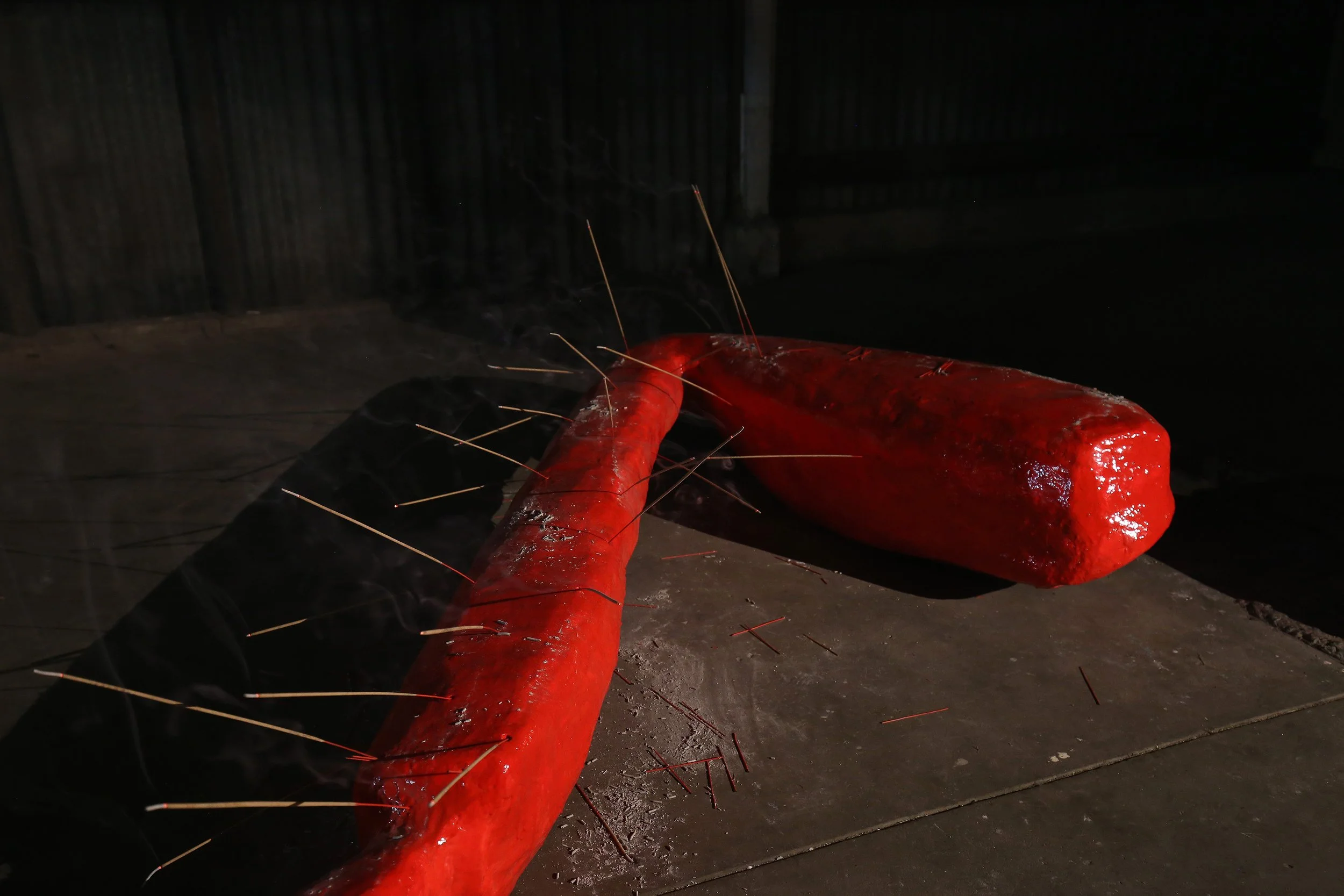
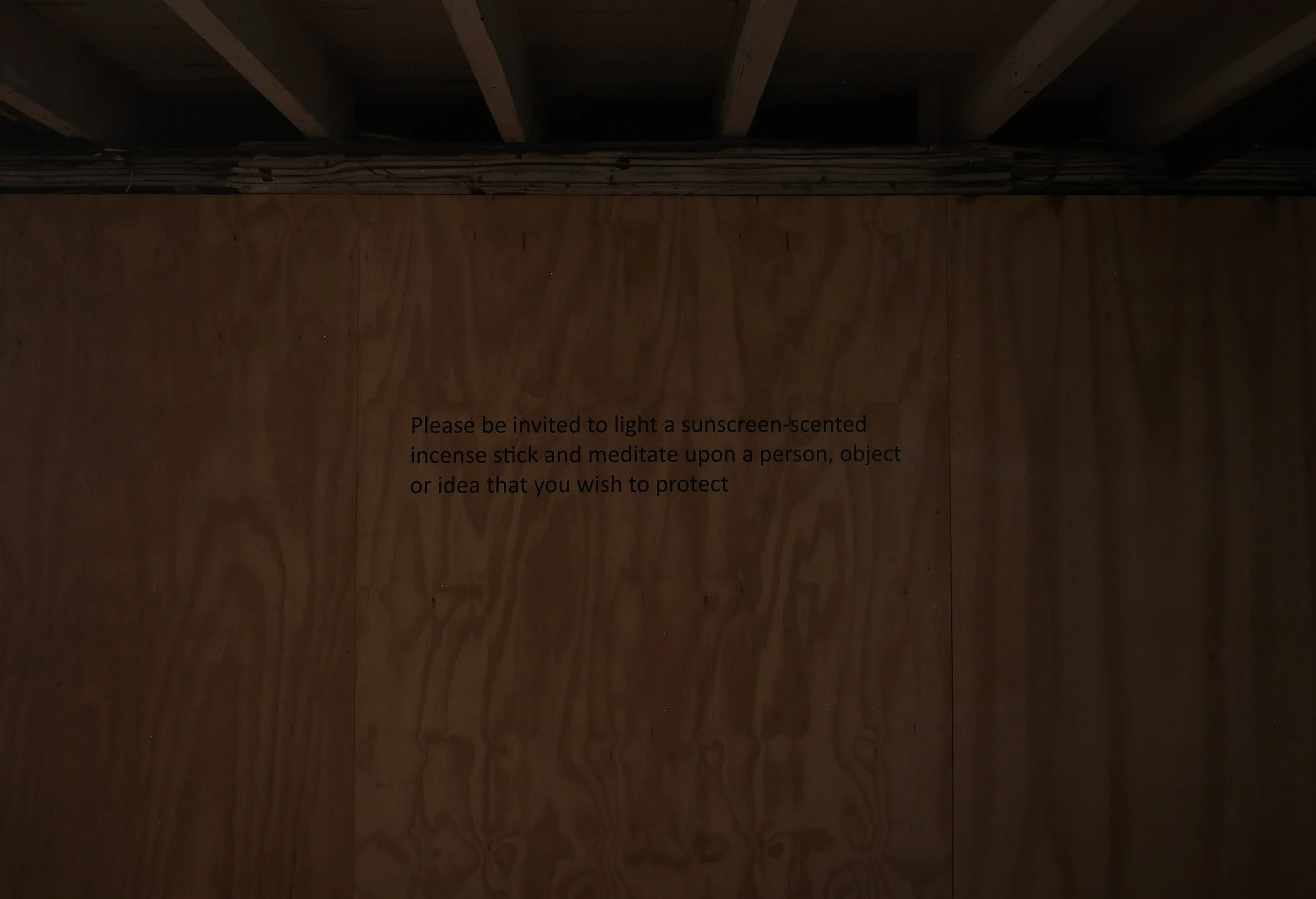
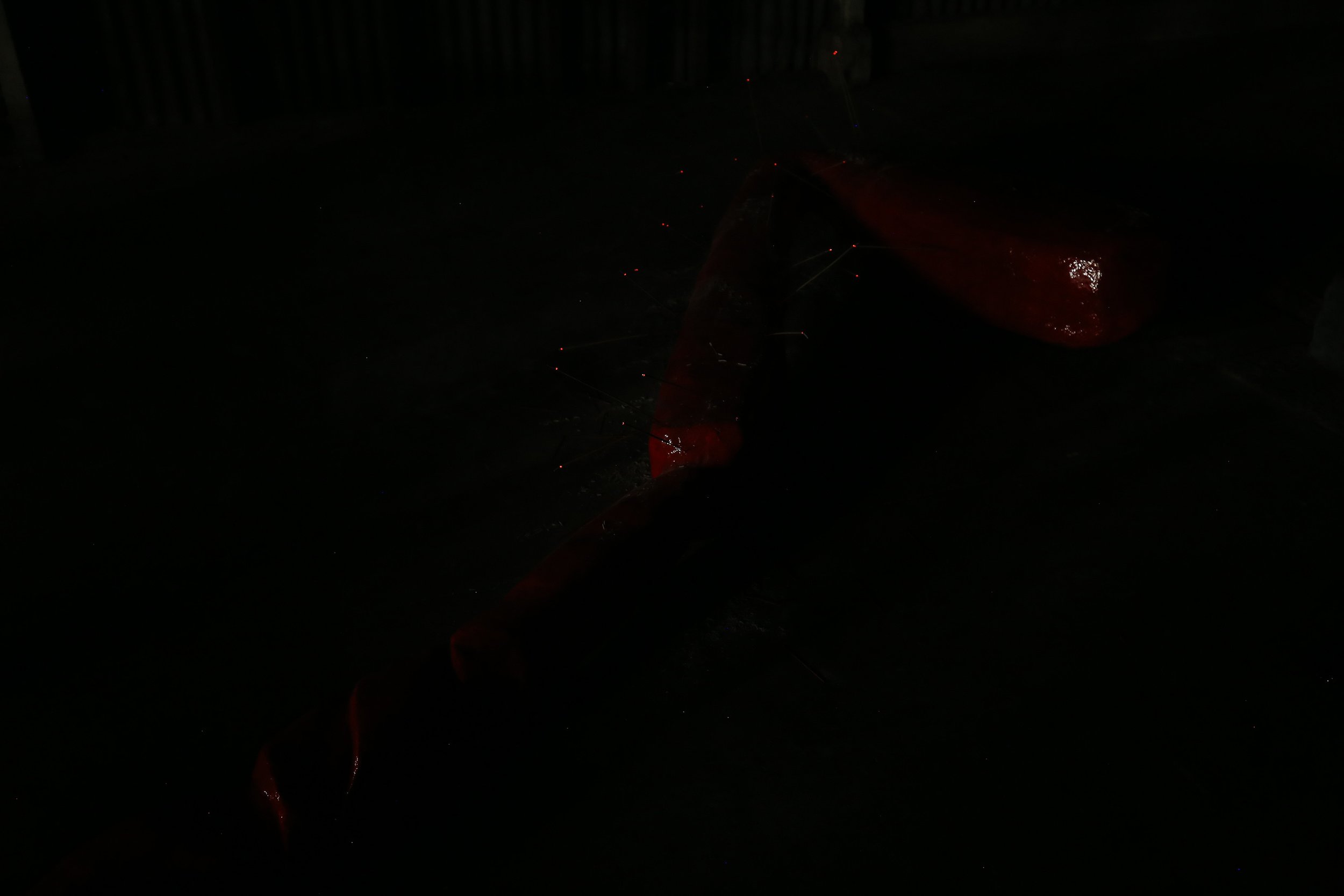
A monumental cockroach leg, lacquered in an almost unnaturally vivid red, rests across the gallery floor. Embedded throughout are handmade incense sticks, individually rolled by the artist from raw incense and infused with a fragrance oil modelled on Coppertone, the iconic American sunscreen brand. The scent circulates through the gallery long before its source becomes apparent, recalling the delayed way in which news of a death is often absorbed, where comprehension trails behind the words themselves.
The leg sculpture also contains the memory of its own making. While carving the Styrofoam form with a large saw, Meg repeatedly discovered live cockroaches nesting inside its white, bubbled core. Styrofoam, a material associated with packaging and protection, had already become a habitat. In south-east Queensland, where cockroaches are all-too-familiar part of suburban life, the discovery shifts the sculpture away from easy associations with infestation or decay. The anecdote remains embedded in the work, becoming another thing the sculpture contains.
Death is never isolated as a singular event. It disperses across the exhibition, settling into the objects, places, and routines that continue after it. The works leave those materials intact, allowing their ordinary histories to remain visible alongside the memories they come to hold.
— Chelsea Hopper
Never Outshine The Master (Death)
6-10 pm, Friday 24 July,
6-8 pm, Friday 31 July
Wreckers Artspace
7 Lotus St, Woolloongabba (downstairs)
The Arts Development Fund is a City of Gold Coast Council fund that supports the Gold Coast’s creative community by fostering professional pathways and skills development, contributing to our city’s vibrant lifestyle.
Photo documentation: Llewellyn Millhouse
Sound: James Hazel
Text: Chelsea Hopper